HALO

Human-Aligned Data Collection for WhoLe-body MObile Manipulation

Shuai Yang1,2,* Fangyi Xu2,* Yishu Shen1 Kecheng Zheng2 Yinghao Xu1,†

1 The Hong Kong University of Science and Technology 2 Robbyant

* Equal contribution   † Corresponding author (e-mail:justimyhxu@ust.hk)

HALO combines kinesthetic teaching with a low-resistance mobility interface to collect coordinated whole-body demonstrations. Operators guide the robot end-effectors directly and move the collection platform through natural locomotion, with the mobile base removed. The platform preserves the deployed base's nonholonomic motion space. Deployment-aligned demonstration processing calibrates and temporally aligns platform motion with the base response and masks and inpaints demonstrator hands in recorded observations. Compared with Mobile ALOHA and VR teleoperation, HALO enables up to 2.9× faster demonstration collection with comparable or higher success rates. Learned policies perform Zip-Tie Fastening and achieve 73.3% success on a six-stage long-horizon mobile manipulation task.
How HALO Works

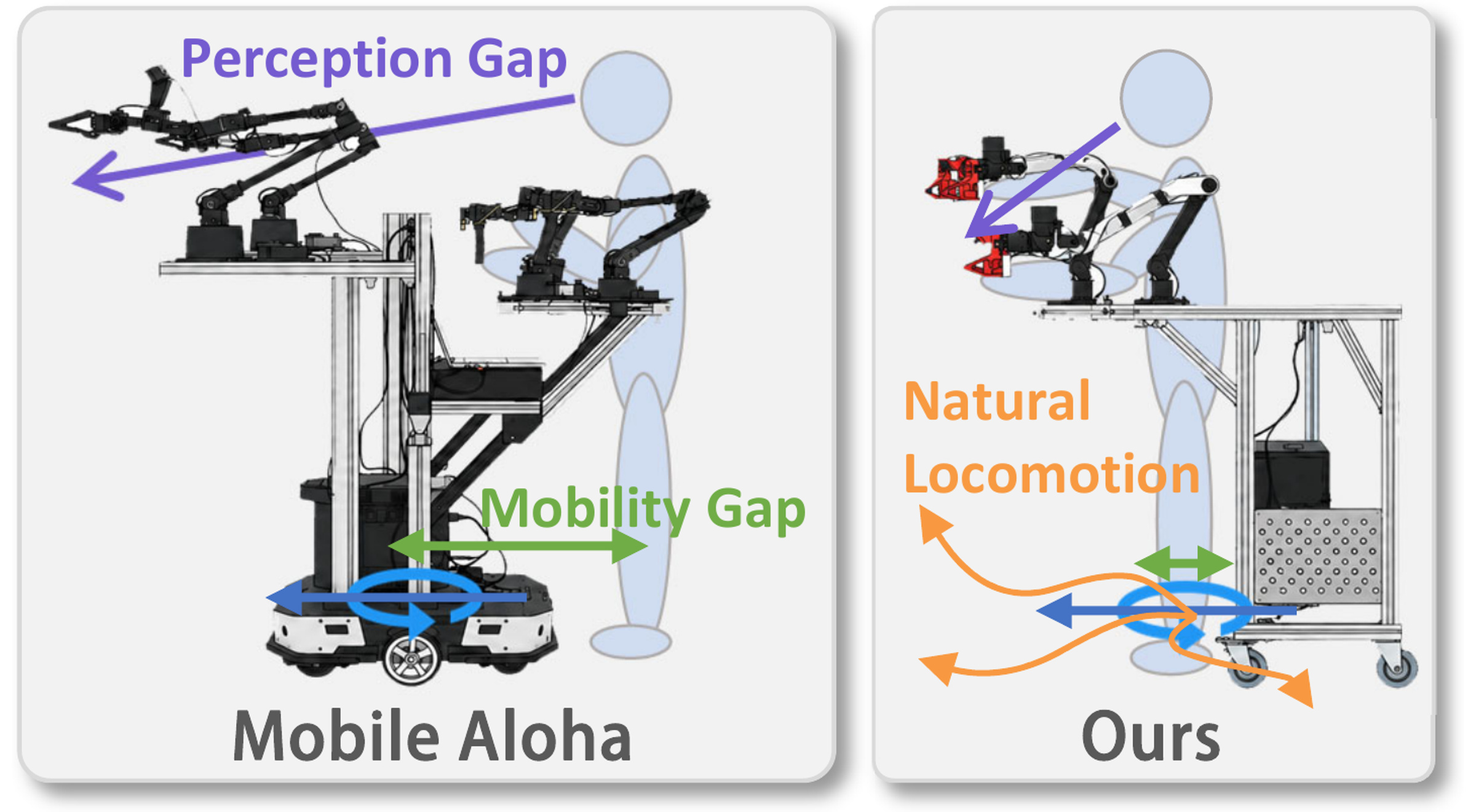
Leader–follower systems spatially separate the operator's hands, viewpoint and robot end-effectors, introducing a perception gap; the powered mobile base also constrains natural operator mobility, creating a mobility gap. HALO uses kinesthetic teaching to align the operator's perception–action space with the robot and removes the base during data collection to preserve natural locomotion. Deployment-aligned demonstration processing addresses the resulting visual and control discrepancies.

Side-view sketch comparing Mobile ALOHA, with perception and mobility gaps, to HALO, where the operator stands at the arms and walks naturally.
Fig. 1 · Mobile ALOHA's perception and mobility gaps, and HALO's aligned interface.

Mechanical Design

HALO combines a manipulation interface, a mobility interface, deployment-aligned demonstration processing, and policy learning. Explore the deployment system and collection platform through the five steps; on desktop, drag the model to look around.

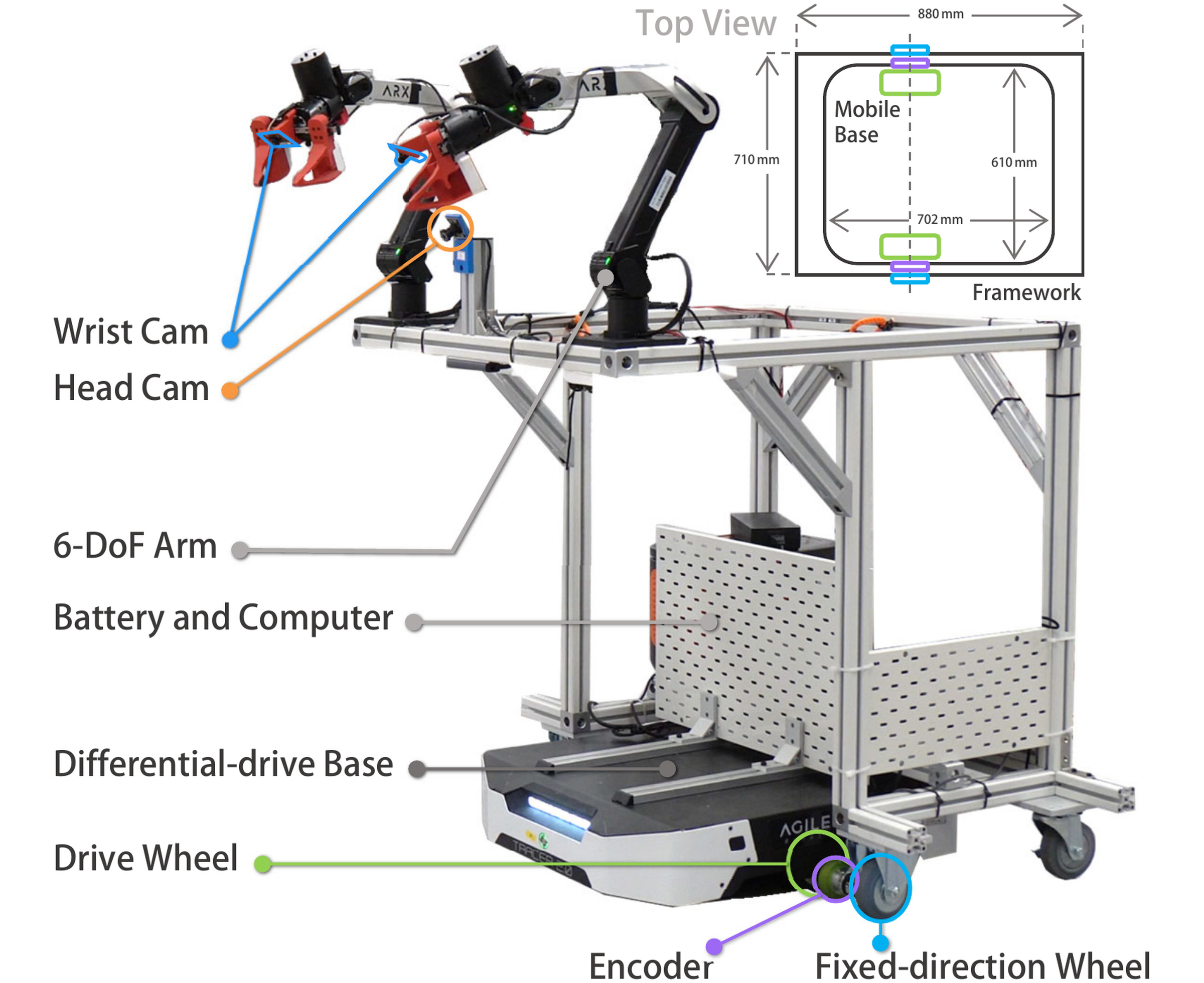
Annotated photo of the HALO deployment system: two 6-DoF arms with wrist cameras, a head camera, the aluminium frame, battery and computer, the differential-drive base with its drive wheel, an encoder and a fixed-direction wheel.

System overview

Drag to rotate

01 · System overview

HALO deployment system

The framework supports two 6-DoF arms, one head camera, two wrist cameras, and the battery and computer. The deployment system uses an AgileX Tracer AGV 2 differential-drive base. The base is removed during data collection.

Arms
2 × 6-DoF arms
Cameras
1 head + 2 wrist
Base
AgileX Tracer AGV 2
Framework
880 × 710 mm

02 · Mobility interface

Mobility interface

Removing the powered mobile base preserves natural locomotion and reduces the horizontal force required for repositioning to 2.3 N. Natural body motion drives the low-resistance collection platform, enabling implicit base control during bimanual manipulation. Passive wheels and two fixed-direction wheels along the drive-wheel axis preserve the deployed base's nonholonomic motion space, without post-hoc retargeting.

Horizontal force to reposition

Deployment system47.3 N
Mobile ALOHA13.0 N
Collection platform2.3 N

03 · Manipulation interface

Kinesthetic end-effector redesign

HALO uses kinesthetic teaching to align the operator's perception and action space with the robot while preserving direct visual and force feedback. The end-effector removes ALOHA's handle-and-scissor mechanism and adopts a compact, high-contact design with increased hand contact area. The redesign reduces end-effector size by more than half and increases the available pitch angle by about 40°.

ALOHA-styleHALO
End-effector size242 mm105 mm
Angle illustrated in Fig. 360.0°17.7°

04 · Data processing

Deployment-Aligned Data Processing

Base motion alignment uses two encoders to measure collection-platform motion. Their readings are converted into left and right platform wheel velocities, uL and uR. An affine mapping converts the measured motion to deployment-compatible base linear and angular velocities, while temporal alignment accounts for the deployed base's response delay.

[vω]=[kvLkvRkωLkωR][uLuR]+[dvdω]\begin{bmatrix}v\\\omega\end{bmatrix}=\begin{bmatrix}k_{vL}&k_{vR}\\k_{\omega L}&k_{\omega R}\end{bmatrix}\begin{bmatrix}u_L\\u_R\end{bmatrix}+\begin{bmatrix}d_v\\d_\omega\end{bmatrix}

The coefficients and offsets are estimated from paired platform measurements and commanded base velocities. The estimated action–state delay is used for temporal alignment. Viewer readouts are illustrative.

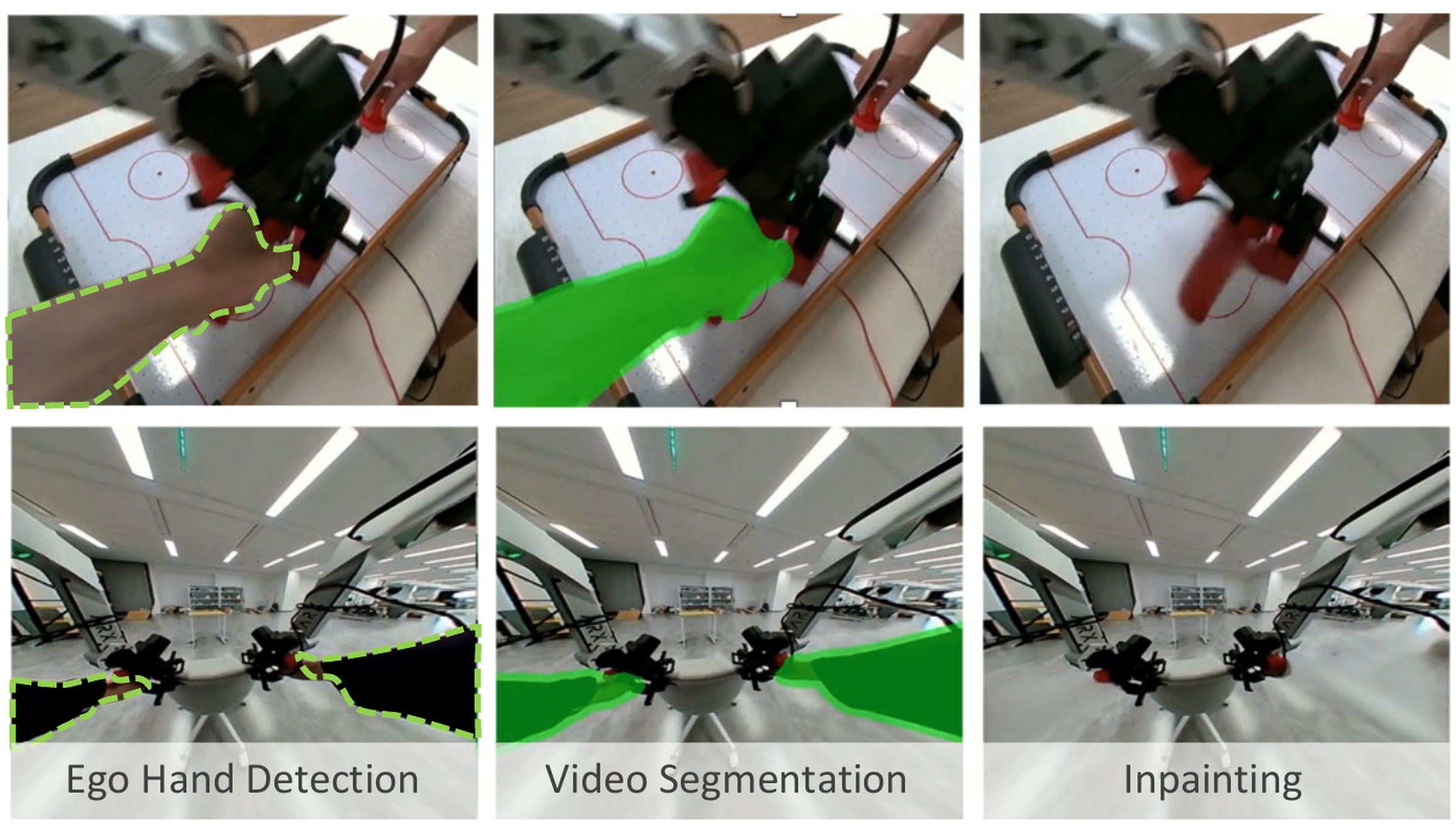
Visual processing removes demonstrator-specific cues: CaRE-Ego detects the operator's hands, SAM2 propagates masks across frames, and DiffuEraser reconstructs the masked regions for observations that better match autonomous execution.

05 · Policy learning

Policy learning

The pretrained π0.5 vision-language-action model is fine-tuned on HALO demonstrations for each task. It receives one head-camera image, two wrist-camera images, robot joint positions, and base linear and angular velocities. The action vector concatenates arm actions with base linear and angular velocities. Asynchronous real-time action chunking (RTC) predicts the next action chunk while the current chunk is executed, conditioning on the committed action prefix to maintain continuity.

Collecting Demonstrations

The operator works with their own hands and walks at a natural pace. The robot's head camera sees those hands, so they are masked and inpainted afterwards, and the training images match what the robot sees on its own.

Operator: natural locomotion + kinesthetic teaching
Robot head camera (inset: after hand removal)

Implicit base control

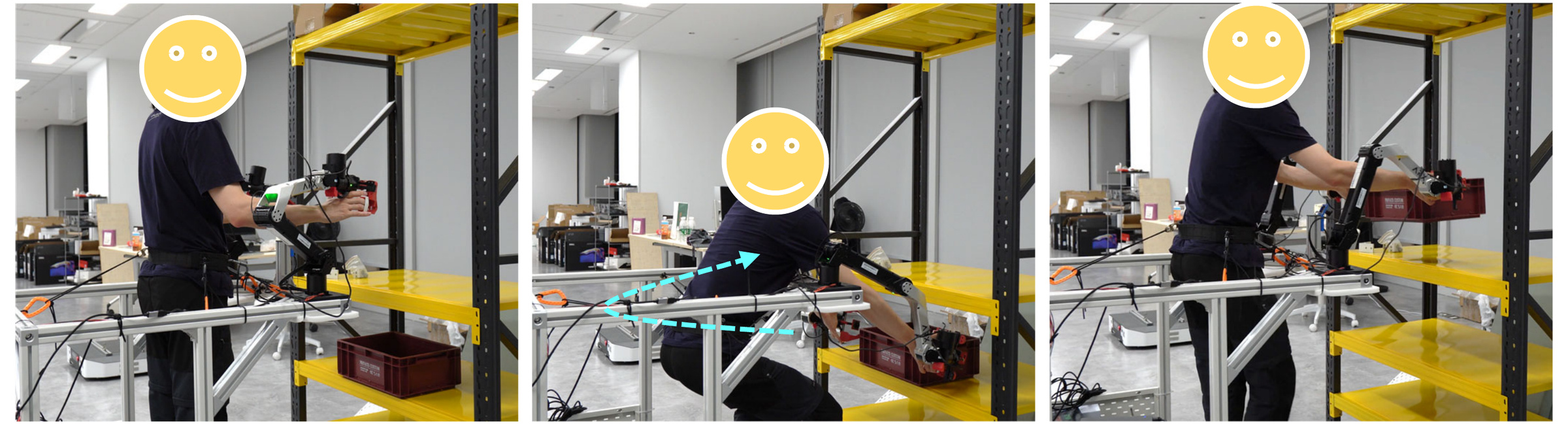
The low-resistance collection platform allows base motion to arise naturally from the operator's movement, without explicit base control that could disrupt hand manipulation, thereby capturing coordinated mobile manipulation behaviors.

Three photos of an operator inside the HALO frame at a shelf, stepping and leaning while the platform follows.
Fig. 5 · Base motion arises from the operator's movement.

Efficiency against VR teleoperation and Mobile ALOHA

Same operator, same tasks, same time budget; the operator had not used any of the interfaces before. Counters in the video track the demonstrations collected with each interface on Push Chair (4× speed).

Successful demonstration time
    Average duration of successful demonstrations, seconds
    TaskHALOMobile ALOHAVR
    Push Chair113230
    Disassemble Lego236437
    Demonstration success rate
      Demonstration success rate, percent
      TaskHALOMobile ALOHAVR
      Push Chair10010025
      Disassemble Lego1008020

      VR's perception gap makes precise gripper control hard; Mobile ALOHA's powered base constrains the operator, who pauses before grasping the chair.

      Deployment-aligned demonstration processing

      Deployment-aligned demonstration processing addresses visual and control discrepancies between demonstration and deployment. In visual processing, CaRE-Ego detects the operator's hands, SAM2 propagates masks across frames, and DiffuEraser reconstructs the masked regions; hand removal improves Push Chair success from 55% to 85%. Base motion alignment fits an affine mapping from platform motion to deployment-compatible base velocities and estimates the action–state delay for temporal alignment.

      Visual processing

      Two example frames processed by ego hand detection, video segmentation and inpainting.
      Fig. 7 · Ego hand detection → video segmentation → inpainting.

      Base motion alignment

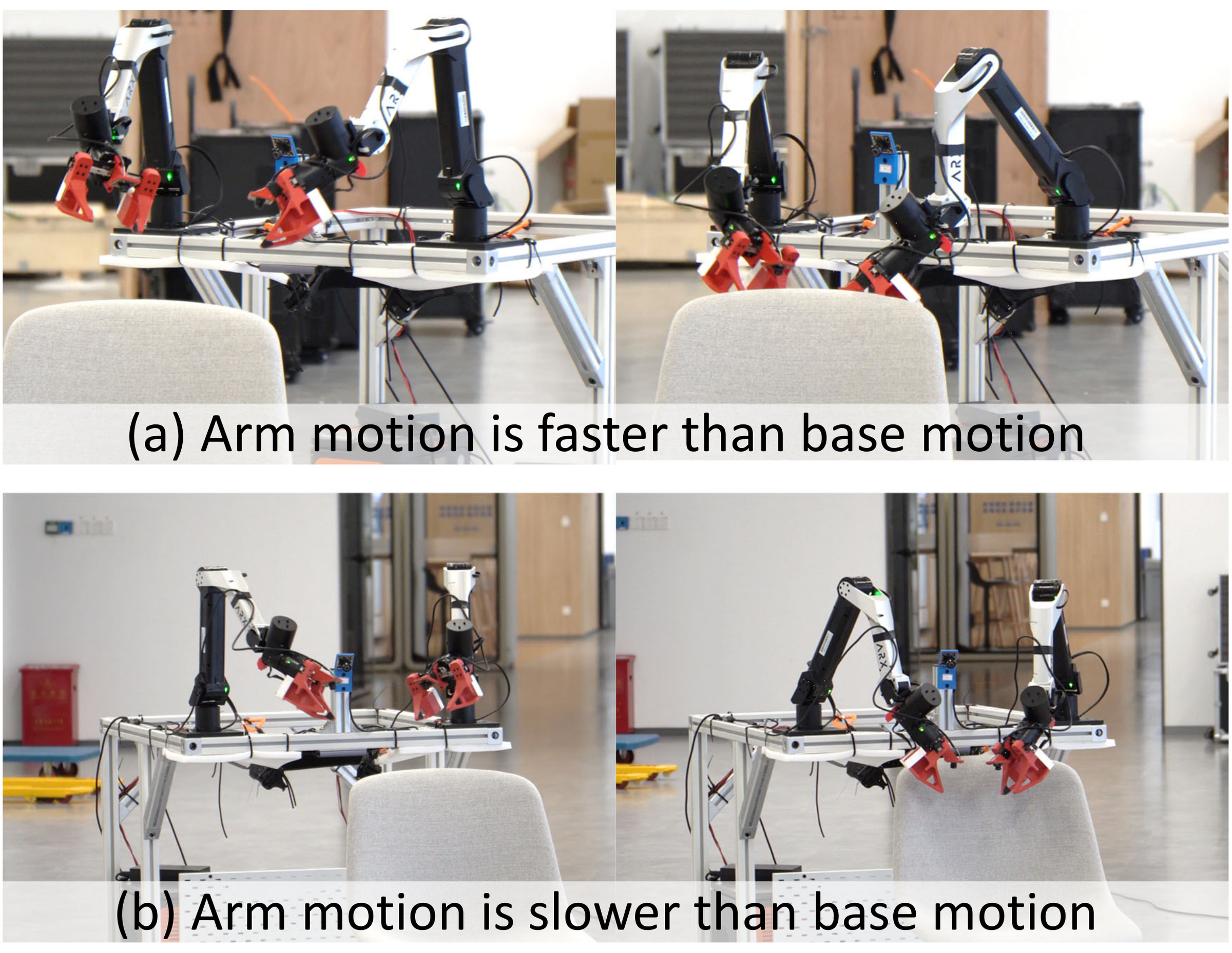
      Failure cases: arm motion faster than base motion, and base travelling too far under synchronous inference.
      Fig. 6 · Failures without latency compensation (a) and with synchronous inference (b).

      What the Policies Learn

      Precise bimanual manipulation, coordinated base and arm motion over long horizons, and generalization beyond the layout seen during collection.

      Generalization of mobile manipulation

      Push Chair asks the robot to grasp a chair with both grippers while moving at about walking speed (~0.7 m/s) and push it under a table. The table never moved during data collection, yet the policy handles 2–3 m changes in its starting pose (Mobile ALOHA used 5–10 cm) and unseen environments. Velocity-based base actions favour a reactive pattern that keeps driving the chair toward the table rather than memorizing a global pose.

      2–3 m initial-pose variation
      Unseen environment

      Dexterity

      Zip-Tie Fastening chains picking, handover, folding, insertion, fastening and placement on a short, small zip tie. The HALO policy succeeds in 30% of 10 trials (41 s on average); policies trained on Mobile ALOHA and VR demonstrations achieve 0% success. In Disassemble Lego the policy succeeds 30 of 40 times, adapts its separation strategy to randomized structures, and generalizes to unseen configurations.

      Zip-Tie Fastening
      Disassemble Lego

      Long-horizon mobile manipulation

      In the long-horizon mobile manipulation task, the robot retrieves a box from a shelf, loads objects into it, lifts it with both arms, drives to a conveyor, places it, and returns to repeat. Despite many forward, backward and turning base motions, the policy brings the base back to its starting pose so the loop can run again: 11 of 15 trials succeed (73.3%).

      Long-horizon mobile manipulation · Retrieve, load, lift, transport, place, and return. 3×.

      Quantitative Results

      Policy success rates on real hardware, and the ablations from the paper. With the same collection budget, policies trained on Mobile ALOHA or VR data fail on Disassemble Lego and the long-horizon mobile manipulation task and score 0% on Zip-Tie Fastening.

      HALO policy success by task
        Task success rate of HALO-trained policies, percent
        TaskHALO policy
        Push Chair85
        Disassemble Lego75
        Long-horizon mobile manipulation73.3
        Zip-Tie Fastening30

        Push Chair: async inference, horizon 8, hands removed · Disassemble Lego 30/40 · Long-horizon mobile manipulation 11/15 · Zip-Tie Fastening 10 trials, 41 s average.

        Inference strategy · Push Chair
          Success rate by execution horizon under synchronous and asynchronous inference, percent
          SettingSuccess rate
          Sync 80
          Sync 2535
          Async 475
          Async 675
          Async 885
          Async 1070

          Sync = synchronous inference; Async = asynchronous inference. Numbers are execution horizons. Asynchronous real-time action chunking (RTC) hides inference pauses; an intermediate horizon balances reactivity and consistency.

          Visual post-processing · Push Chair
            Success rate with and without visual post-processing, percent
            Training imagesSuccess rate
            Raw (hands visible)55
            Hands removed85

            Same demonstrations, best inference setting; only the visual processing differs.

            Action representation · Disassemble Lego
              Success rate by action space and initialization, percent
              Action spaceFrom VLMPretrained VLA
              End-effector (EEF)12.547.5
              Joint-space7.575

              End-effector (EEF) actions do better from scratch; joint-space actions do better after VLA pretraining.

              Supplementary Video

              BibTeX

              @inproceedings{halo2026,
                title     = {HALO: Human-Aligned Data Collection for Whole-body Mobile Manipulation},
                author    = {TODO: author list},
                booktitle = {TODO: venue},
                year      = {TODO}
              }